
| Editorial Team |
| Peer-Reviewer |
| Focus and Scope |
| Editorial Policies |
| Author Guidelines |
| Publication Ethics |
| Screening for Plagiarism |
| Online Submission |
| Author Fees |
Editorial Policies
- Focus and Scope
- Peer review process
- Publication frequency
- Open access policy
- Authorship
- Acknowledgments
- Research data
- Conflict of interest
- Publication ethics
- Screening for plagiarism
- Reference Management
Focus and scope
The aim of this journal publication is to disseminate the conceptual thoughts or ideas and research results that have been achieved in the area of policies and public administrations. The journal particularly focuses on the main problems in the development of the sciences of public policies and administration areas as follows:
- Governance
- Regional autonomy
- Government bureucracy
- Human resource management
- Public service
- Public policy
- Digital governance
- Public management
- Leadership
- Administrative reform
- Strategic management
Peer review process
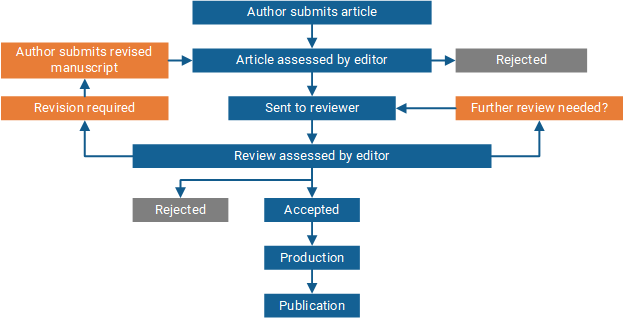
Every article that goes to the editorial staff will be selected through Initial Review processes by Editorial Board. Then, the articles will be sent to the peer reviewer and will go to the next selection by Blind Preview Process. After that, the articles will be returned to the authors to revise. These processes take a month for a maximum time. In the each manuscript, peer reviewer will be rated from the substantial and technical aspects. Peer reviewer that collaborated with Jurnal SIKAP (Solusi Ilmiah Kebijakan dan Administrasi Publik) is the experts in the public administration area and issues around it. They were experienced in the prestigious journal management and publication that was spread around the national and abroad. Manuscript processing time as follows:
- The author has 10 days waiting period on the first article submission, the section editor will decide whether the article needs to be revised or not
- Section editor needs 3 days to examine the article based on Jurnal SIKAP (Solusi Ilmiah Kebijakan dan Administrasi Publik) author guideline
- Author has 7 days to revise the article consistent with the Jurnal SIKAP (Solusi Ilmiah Kebijakan dan Administrasi Publik) author guideline
- The revised article given to the editor to be reviewed, the editorial team needs 15 days to finish the review.
- If the article Declined, section editor has 3 days to inform the author regarding the editorial team decision
- If the article Revision Required, editorial team will proceed the article to the reviewer
- Reviewer has 30 days to review the article divided into two times review and provide the decision, Accepted or Declined
- The editorial team discusses the final decision in an editorial team meeting whether the articles recommended by the reviewers proceed to be Published or Declined. The editorial team has 20 days to make the final decision.
- The soon-to-be-published articles, lay-outed by the section editor for 30 days
- Author has 3 days to confirm the layout result.
- Section editor publishes the accepted articles.
Publication frequency
Jurnal SIKAP (Solusi Ilmiah Kebijakan dan Administrasi Publik) is published twice a year, in April and October.
Open access policy

All research articles published in Jurnal SIKAP (Solusi Ilmiah dan Kebijakan Publik) are fully open access: immediately freely available to read, download and share. Articles are published under the terms of a Creative Commons Attribution 4.0 International (CC BY-SA 4.0) license which permits use, distribution and reproduction in any medium, remix, transform, and build upon the material for any purpose, you must give appropriate credit to the the original work by cite it properly.
Authorship
Author
All parties who have made a substantive contribution to the article should be listed as authors. Principal authorship, authorship order, and other publication credits should be based on the relative scientific or professional contributions of the individuals involved, regardless of their status. A student is usually listed as principal author on any multiple-authored publication that substantially derives from the student’s dissertation or thesis.
Corresponding author
The one individual who takes primary responsibility for communication with the journal during the manuscript submission, peer review, and publication process, and typically ensures that all the journal’s administrative requirements, such as providing details of authorship, ethics committee approval, clinical trial registration documentation, and gathering conflict of interest forms and statements, are properly completed, although these duties may be delegated to one or more co-authors.
The corresponding author is the person who signs the publishing agreement on behalf of all of the authors and whose contact details are included on the article. They should be available after publication to respond to critiques of the work and cooperate with any requests from the journal for data or additional information should questions about the paper arise after publication.
Third party submissions
Where an individual who is not listed as an author submits a manuscript on behalf of the author(s), a statement must be included in the Acknowledgements section of the manuscript and in the accompanying cover letter. The statements must:
- Disclose this type of editorial assistance – including the individual’s name, company and level of input
- Identify any entities that paid for this assistance
- Confirm that the listed authors have authorized the submission of their manuscript via third party and approved any statements or declarations, e.g. conflicting interests, funding, etc.
Where appropriate, Jurnal SIKAP (Solusi Ilmiah Kebijakan dan Administrasi Publik) reserves the right to deny consideration to manuscripts submitted by a third party rather than by the authors themselves.
Acknowledgments
Those whose contributions do not justify authorship may be acknowledged individually or together as a group under a single heading, and their contributions should be specified. Because acknowledgment may imply endorsement by acknowledged individuals of a study’s data and conclusions, editors are advised to require that the corresponding author obtain written permission to be acknowledged from all acknowledged individuals.
Research data
We are committed to facilitating openness, transparency and reproducibility of research. Where relevant, Jurnal SIKAP (Solusi Ilmiah Kebijakan dan Administrasi Publik) encourages authors to share their research data in a suitable public repository subject to ethical considerations and where data is included, to add a data accessibility statement in their manuscript file. Authors should also follow data citation principles.
Conflict of interest
General Policy and Sources of Funding
Authors are required to disclose all sources of institutional, private, and corporate financial support for their study. Authors are also required to disclose any potential conflicts of interest. An author's conflict of interest or information specifying the absence of conflicts of interest, and the sources of funding for the research will be published under a separate heading entitled "Conflict of Interest".
Submission by an Editor or by Author Whose Relationship With Editor Might Create The Perception of Bias
If a submitting author and editor of the SEAM have a relationship that may create a perception of bias, an alternative editor from another institute will be elected to oversee the manuscript. This editor will select the reviewers and have the final decision regarding the paper. The submitting editor will not have access to any information or correspondence relating to the submission that is not meant for the authors.
Potential conflict of interest for reviewers
The invitation letter to reviewers will include the following paragraph: ‘If you know, or think you know, the identity of the author, or if you feel there is any potential conflict of interest in your reviewing this paper (e.g. friendship or conflict/rivalry) please declare it immediately. By accepting this invitation, it is assumed there is no potential conflict of interest.' If a conflict of interest has been declared, standard policy declares that an alternate reviewer must be used however this is at the editors' discretion.
Publication ethics
The following is a code of ethics for SIKAP (Solusi Ilmiah Kebijakan dan Administrasi Publik) authors, editors, and reviewers who are adapted from the Publications Ethics Committee (COPE)[1][2]. This ethic maintains the integrity, accountability and scientific principles in the field of research and publications which must be adhered to.
Duties of Authors
- Reporting Standards:
Authors of reports of original research should present an accurate account of the work performed as well as an objective discussion of its significance. Underlying data should be represented accurately in the paper. A paper should contain sufficient detail and references to permit others to replicate the work. Fraudulent or knowingly inaccurate statements constitute unethical behaviour and are unacceptable. - Data Access and Retention:
Authors are asked to provide the raw data in connection with a paper for editorial review, and should be prepared to provide public access to such data (consistent with the ALPSP-STM Statement on Data and Databases), if practicable, and should in any event be prepared to retain such data for a reasonable time after publication. - Originality and Plagiarism:
The authors should ensure that they have written entirely original works, and if the authors have used the work and/or words of others that this has been appropriately cited or quoted. - Multiple, Redundant or Concurrent Publication:
An author should not, in general, publish manuscripts describing essentially the same research in more than one journal or primary publication. Submitting the same manuscript to more than one journal concurrently constitutes unethical publishing behaviour and is unacceptable. - Acknowledgement of Sources:
Proper acknowledgement of the work of others must always be given. Authors should cite publications that have been influential in determining the nature of the reported work. - Authorship of the Paper:
Authorship should be limited to those who have made a significant contribution to the conception, design, execution, or interpretation of the reported study. All those who have made significant contributions should be listed as co-authors. Where there are others who have participated in certain substantive aspects of the research project, they should be acknowledged or listed as contributors. The corresponding author should ensure that all appropriate co-authors and no inappropriate co-authors are included on the paper and that all co-authors have seen and approved the final version of the paper and have agreed to its submission for publication. - Disclosure and Conflicts of Interest:
All authors should disclose in their manuscript any financial or another substantive conflict of interest that might be construed to influence the results or interpretation of their manuscript. All sources of financial support for the project should be disclosed. - Fundamental errors in published works:
When an author discovers a significant error or inaccuracy in his/her own published work, it is the author’s obligation to promptly notify the journal editor or publisher and cooperate with the editor to retract or correct the paper. - Hazards and Human or Animal Subjects:
If the work involves chemicals, procedures or equipment that have any unusual hazards inherent in their use, the author must clearly identify these in the manuscript.
Duties of Editors
- Fair Play:
An editor at any time evaluate manuscripts for their intellectual content without regard to race, gender, sexual orientation, religious belief, ethnic origin, citizenship, or political philosophy of the authors. - Confidentiality:
The editor and any editorial staff must not disclose any information about a submitted manuscript to anyone other than the corresponding author, reviewers, potential reviewers, other editorial advisers, and the publisher, as appropriate. - Disclosure and Conflicts of Interest:
Unpublished materials disclosed in a submitted manuscript must not be used in an editor's own research without the express written consent of the author. - Publication Decisions:
The editor board journal is responsible for deciding which of the articles submitted to the journal should be published. The validation of the work in question and its importance to researchers and readers must always drive such decisions. The editors may be guided by the policies of the journal's editorial board and constrained by such legal requirements as shall then be in force regarding libel, copyright infringement and plagiarism. The editors may confer with other editors or reviewers in making this decision. - Review of Manuscripts:
The editor must ensure that each manuscript is initially evaluated by the editor for originality. The editor should organize and use peer review fairly and wisely. Editors should explain their peer review processes in the information for authors and also indicate which parts of the journal are peer reviewed. The editor should use appropriate peer reviewers for papers that are considered for publication by selecting people with sufficient expertise and avoiding those with conflicts of interest.
Duties of Reviewers
- Contribution to Editorial Decisions:
Peer review assists the editor in making editorial decisions and through the editorial communications with the author may also assist the author in improving the paper. - Promptness:
Any selected referee who feels unqualified to review the research reported in a manuscript or knows that its prompt review will be impossible should notify the editor and excuse himself from the review process - Standards of Objectivity:
Reviews should be conducted objectively. Personal criticism of the author is inappropriate. Referees should express their views clearly with supporting arguments. - Confidentiality:
Any manuscripts received for review must be treated as confidential documents. They must not be shown to or discussed with others except as authorized by the editor. - Disclosure and Conflict of Interest:
Privileged information or ideas obtained through peer review must be kept confidential and not used for personal advantage. Reviewers should not consider manuscripts in which they have conflicts of interest resulting from competitive, collaborative, or other relationships or connections with any of the authors, companies, or institutions connected to the papers. - Acknowledgement of Sources:
Reviewers should identify relevant published work that has not been cited by the authors. Any statement that an observation, derivation, or argument had been previously reported should be accompanied by the relevant citation. A reviewer should also call to the editor's attention any substantial similarity or overlap between the manuscript under consideration and any other published paper of which they have personal knowledge.
Screening for plagiarism
All work in the manuscript should be free of any plagiarism, falsification, fabrications, or omission of significant material. Every article submitted to the Jurnal SIKAP (Solusi Ilmiah Kebijakan dan Administrasi Publik) will be checked by Plagiarism Checker X software. Articles with a plagiarism result exceeding 30% will be rejected promptly. The author is able to resubmit the article after he/she revises his/her work significantly. The editors will only process the article reaching below the 30% similarity limit.
Authors are advised to do a plagiarism check independently before submitting the article. Recommended plagiarism tools are Plagiarism Checker X and Turnitin.
Reference Management
Jurnal SIKAP (Solusi Ilmiah Kebijakan dan Administrasi Publik) provides reference template available in many of the most popular reference management software products. These include all products that support Citation Style Language styles, such as Mendeley, Zotero, EndNote and BibTex. Using the word processor plug-ins from these products, authors only need to select the appropriate journal template when preparing their article, after which citations and bibliographies will be automatically formatted in the journal's style. If no template is yet available for this journal, please follow the format of the sample references and citations as shown in this Guide.

.png)
.png)


